
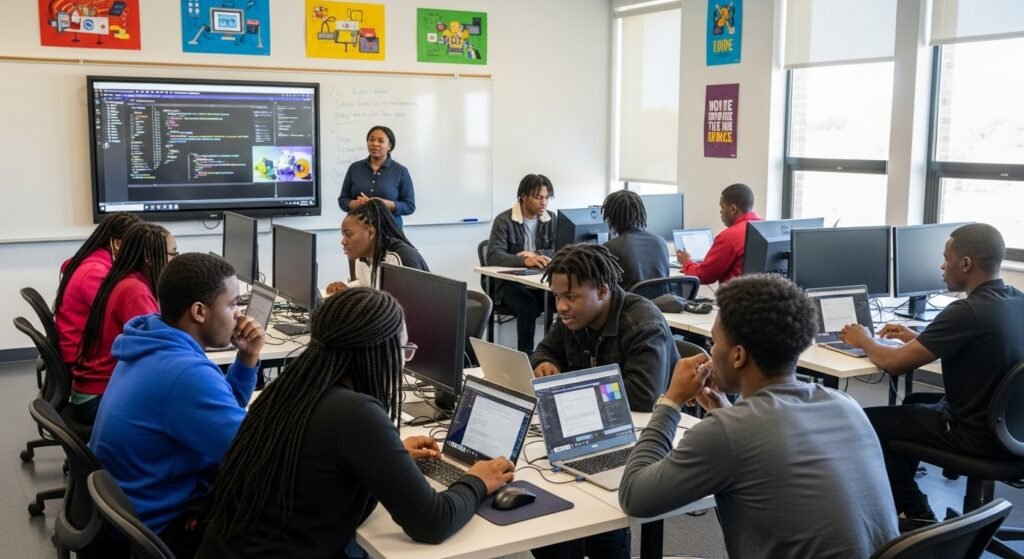
Africa is standing at a pivotal demographic crossroads. It is the world’s youngest continent, with 60% of its population under the age of 25. By 2030, young Africans are expected to constitute 42% of global youth.
This “youth bulge” is often presented as a double-edged sword. On one side, it represents an immense reservoir of talent, energy, and creativity—a potential demographic dividend that could power global growth. On the other side lies the stark reality of high youth unemployment and underemployment.
The bridge between this immense potential and economic reality? Digital skills.
In the Fourth Industrial Revolution (4IR), digital literacy is no longer an optional “add-on” to a CV; it is the fundamental currency of empowerment. Here is why equipping Africa’s youth with digital skills is not just a development goal, but the essential strategy for the continent’s future.
1. Breaking Down Geographical Barriers to Employment
For decades, economic opportunity in Africa was heavily tied to location. If you lived outside major economic hubs like Lagos, Nairobi, or Johannesburg, your career options were severely limited.
Digital skills shatter these geographical constraints. The rise of remote work and the global gig economy means that a skilled graphic designer in Accra can work for a client in New York, and a data analyst in Kigali can contribute to a team in Berlin.
By mastering digital tools, African youth are no longer just competing for scarce local jobs; they are entering a borderless global marketplace. This doesn’t just provide income; it imports foreign currency and builds international networks.
2. Fueling “Homegrown” Innovation and Entrepreneurship
Africa’s youth are not just looking for jobs; they are creating them. The continent is already a global leader in mobile money adoption, proving its ability to technological leapfrog older infrastructure.
Digital skills are the bedrock of this entrepreneurial spirit. We are seeing a surge in African tech startups solving distinctly African problems:
- Fintech: Startups providing banking services to the unbanked through smartphones.
- Agritech: Young farmers using apps to monitor weather patterns, access markets, and improve yields.
- Healthtech: Platforms connecting patients in remote areas with doctors via telemedicine.
When young people know how to code, analyze data, or leverage digital marketing, they can turn an idea into a scalable business that serves their community and drives the local economy.
3. Future-Proofing the Workforce
The nature of work is changing globally. Automation and AI are reshaping traditional industries like agriculture, manufacturing, and mining—sectors that remain crucial to African economies.
To ensure that Africa’s workforce is not left behind by the 4IR, digital upskilling is non-negotiable. We don’t just need software engineers; we need digitally literate farmers using precision agriculture tools, healthcare workers managing digital records, and teachers utilizing e-learning platforms.
Preparing youth with these skills today is future-proofing the continent’s economy against the disruptions of tomorrow.
4. Amplifying Voices and Civic Engagement
Empowerment isn’t solely economic; it’s also social and civic. Digital literacy gives young Africans a voice on the global stage.
Social media and digital platforms have become critical tools for advocacy, community organizing, and holding leaders accountable. A digitally savvy generation is better equipped to access information, fight misinformation, participate in governance, and organize for social change. Digital skills provide the megaphone for a generation eager to shape their own narrative.
The Path Forward: Bridging the Divide
While the potential is immense, we must acknowledge the hurdles. The “digital divide” in Africa remains real. Issues of affordable internet access, reliable electricity, and the high cost of hardware still exclude too many young people, particularly in rural areas and among young women.
Therefore, prioritizing digital skills requires a multi-stakeholder approach:
- Governments must incentivize infrastructure investment and integrate digital literacy into national curricula from an early age.
- The Private Sector must invest in training programs and boot camps that align skills with actual market needs.
- Educational Institutions must pivot faster, moving beyond rote learning to teach critical thinking, complex problem-solving, and digital fluency.
Conclusion
The narrative of Africa as a continent in need of aid is outdated. The new narrative is Africa as a continent of immense untapped talent.
Investments in digital skills are not merely technical training; they are investments in human capital, dignity, and self-determination. By placing digital tools in the hands of Africa’s youth, we aren’t just helping them find work—we are empowering them to build the future they deserve. The digital horizon in Africa is bright, and its youth are ready to lead the way.